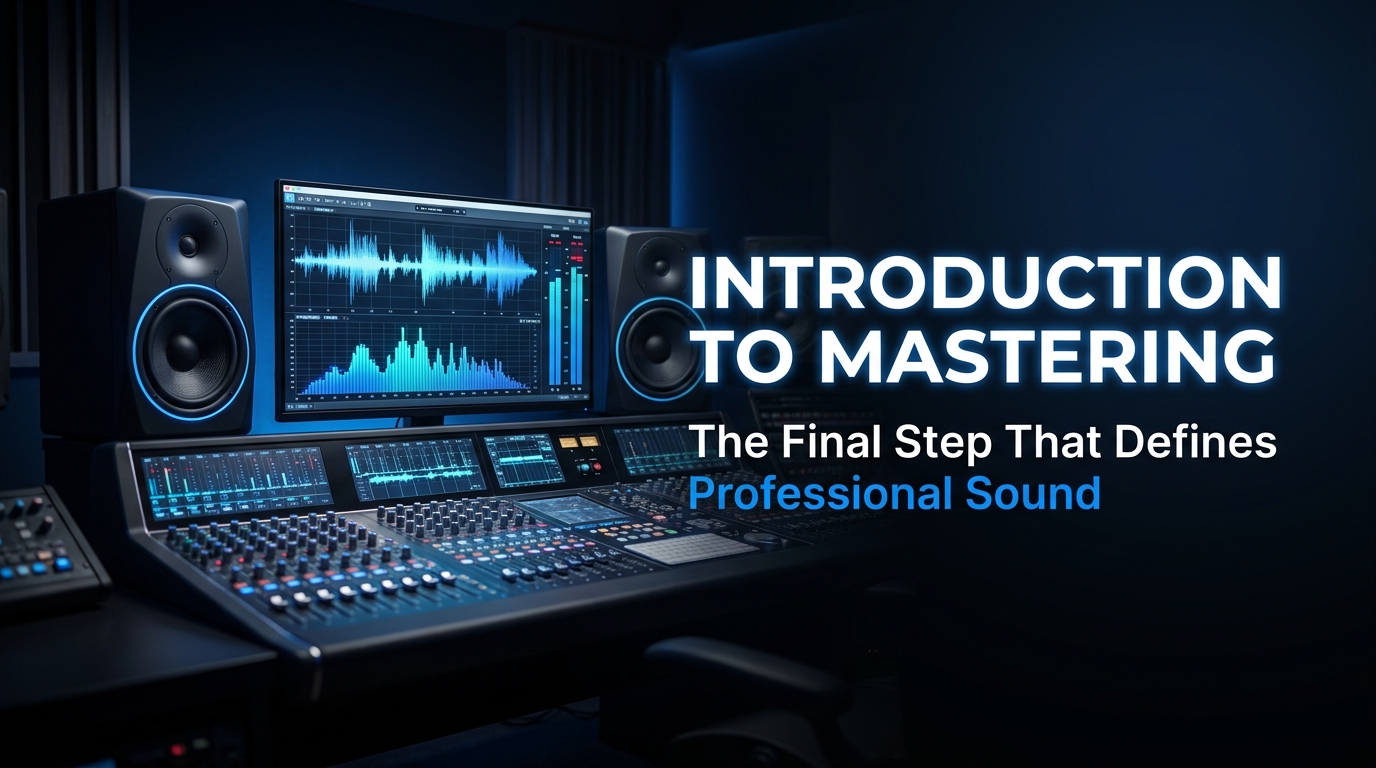
Introduction to Mastering: The Final Step That Defines Professional Sound
In modern music production, mastering is often misunderstood. Many producers think it is simply about making a track louder. In reality, mastering is the process that transforms a finished mix into a polished, release-ready record.
Whether your music will be streamed on Spotify, played in clubs, or listened to on headphones, mastering ensures your track sounds consistent, balanced, and competitive across every listening environment.
Mastering is not just a technical step — it is the final quality control stage before your music reaches the world.
What Is Mastering in Music Production?
Mastering is the final stage of the music production process, performed after recording and mixing. Its purpose is to refine the overall sound, correct small issues, and prepare the track for distribution on streaming platforms, radio, and digital stores.
The mastering process focuses on the song as a whole rather than individual tracks, making subtle adjustments to ensure clarity, balance, and consistency. (Oboe)
In simple terms:
Recording captures performances
Mixing balances individual elements
Mastering prepares the final product for release
This three-stage workflow defines the foundation of professional music production. (Disc Makers Blog)
Why Mastering Is So Important Today
Music is consumed on many different devices:
- Smartphones
- Car speakers
- Bluetooth headphones
- Club sound systems
- Studio monitors
- Laptops
Because of this diversity, mastering has become more important than ever. The goal is to ensure your track sounds good everywhere — not just in your studio.
A properly mastered track will:
- Sound louder and clearer
- Maintain consistent volume levels
- Translate well across playback systems
- Compete with commercial releases
- Meet streaming platform standards
Mastering is essentially your music’s final opportunity to achieve professional quality before release.
The Core Goals of Mastering
Professional mastering typically focuses on three main objectives:
1) Improve Sound Quality
This includes:
- Enhancing clarity
- Balancing frequencies
- Controlling dynamics
- Removing unwanted noise
- Improving stereo image
The goal is not to dramatically change the mix, but to refine and polish it.
2) Ensure Consistency
Consistency is especially important for:
- Albums
- EPs
- Sample packs
- Vocal packs
- Music libraries
Mastering ensures all tracks maintain similar loudness and tonal balance, preventing listeners from constantly adjusting the volume between songs. (Oboe)
3) Prepare Audio for Distribution
This includes:
- Export formats
- Sample rate conversion
- Dithering
- Loudness standards
- Metadata preparation
The final master file is what gets uploaded to streaming platforms and distributors.
The Modern Mastering Workflow (Step-by-Step)
While workflows vary between engineers, most mastering sessions follow a structured process.
Step 1 — Critical Listening
Before applying any processing, the engineer listens carefully to the track to identify:
- Frequency imbalances
- Dynamic issues
- Distortion
- Noise
- Stereo problems
Listening is the most important step in mastering.
Step 2 — Equalization (EQ)
EQ is used to make subtle adjustments to the tonal balance of the track.
Common goals include:
- Adding clarity to vocals
- Controlling harsh frequencies
- Enhancing low-end definition
- Improving overall balance
Mastering EQ changes are typically very small compared to mixing adjustments.
Step 3 — Dynamic Control
Dynamic processing helps control volume differences between quiet and loud sections.
Common tools include:
- Compressor
- Multiband compressor
- Limiter
These tools help increase loudness while maintaining musical dynamics.
Step 4 — Stereo Enhancement
Stereo processing improves spatial balance and width.
This step may involve:
- Stereo widening
- Mid/Side processing
- Phase correction
The goal is to create a wide, clear sound without losing focus.
Step 5 — Loudness Optimization
Modern mastering requires meeting loudness standards for streaming platforms.
Typical loudness targets:
- Streaming: −14 LUFS
- Club / EDM: −8 to −6 LUFS
- Broadcast: varies by region
Loudness is controlled using limiters and gain staging.
Step 6 — Final Export and Quality Control
The last step ensures the track is technically correct.
This includes:
- Checking peak levels
- Verifying file format
- Testing playback on multiple systems
- Exporting the final master
The result is a distribution-ready audio file.
The Difference Between Mixing and Mastering
This is one of the most common questions among producers.
Mixing focuses on:
- Individual tracks
- Balance between instruments
- Effects and processing
- Arrangement clarity
Mastering focuses on:
- The final stereo mix
- Overall sound quality
- Loudness and consistency
- Distribution readiness
Mastering is the final refinement stage that ensures the music translates well across different playback environments. (Mastering The Mix)
Common Mastering Tools Used by Producers
Modern mastering relies on a small set of core tools.
Essential Mastering Processors
- Equalizer (EQ)
- Compressor
- Limiter
- Stereo Imager
- Saturation
- Metering tools
- Clipper
- Dither
These tools allow engineers to control frequency balance, dynamics, and loudness — the three core elements of mastering. (Production Music Live)
The Rise of AI Mastering
One of the biggest changes in recent years is the emergence of automated mastering tools powered by artificial intelligence.
AI mastering can:
- Analyze audio automatically
- Apply optimized processing
- Match commercial loudness levels
- Reduce production time
- Provide consistent results
This technology is making mastering more accessible to independent producers and content creators.
However, professional mastering engineers still provide advantages in:
- Critical listening
- Artistic decisions
- Genre-specific adjustments
- Quality control
Mastering for Streaming Platforms
Streaming services have changed how mastering works.
In the past, louder tracks often sounded better. Today, streaming platforms normalize volume automatically.
This means:
Excessive loudness can reduce audio quality
Balanced dynamics are more important than raw volume
Consistency is critical
Modern mastering focuses on clarity and translation rather than maximum loudness.
Common Mistakes Beginners Make in Mastering
Many producers struggle with mastering because they misunderstand its purpose.
Here are the most common mistakes:
Over-compressing the track
Pushing loudness too far
Using too many plugins
Ignoring reference tracks
Mastering a poor mix
Skipping quality control
One of the most important lessons in mastering is simple:
A great master starts with a great mix.
Mastering for Different Types of Producers
Different producers use mastering in different ways.
Independent Artists
Goals:
- Release music independently
- Upload tracks to streaming platforms
- Maintain professional sound quality
Content Creators
Goals:
- Consistent audio levels
- Clear playback on mobile devices
- Fast production workflow
Professional Producers
Goals:
- Competitive loudness
- Reliable translation
- High-end sound quality
Understanding your production goals helps define the right mastering approach.
The Future of Mastering
Mastering continues to evolve with technology and distribution platforms.
Future trends include:
AI-assisted mastering
Real-time cloud mastering
Automatic loudness matching
Integrated mastering tools in DAWs
Smart audio analysis
These innovations will continue to make mastering faster and more accessible.
Conclusion
Mastering is the final step that transforms a finished mix into a professional release.
It ensures your music sounds clear, consistent, and competitive across all listening environments. Without proper mastering, even a great song can sound unpolished or inconsistent.
For modern producers, mastering is not optional — it is an essential part of delivering professional-quality music to the world.