
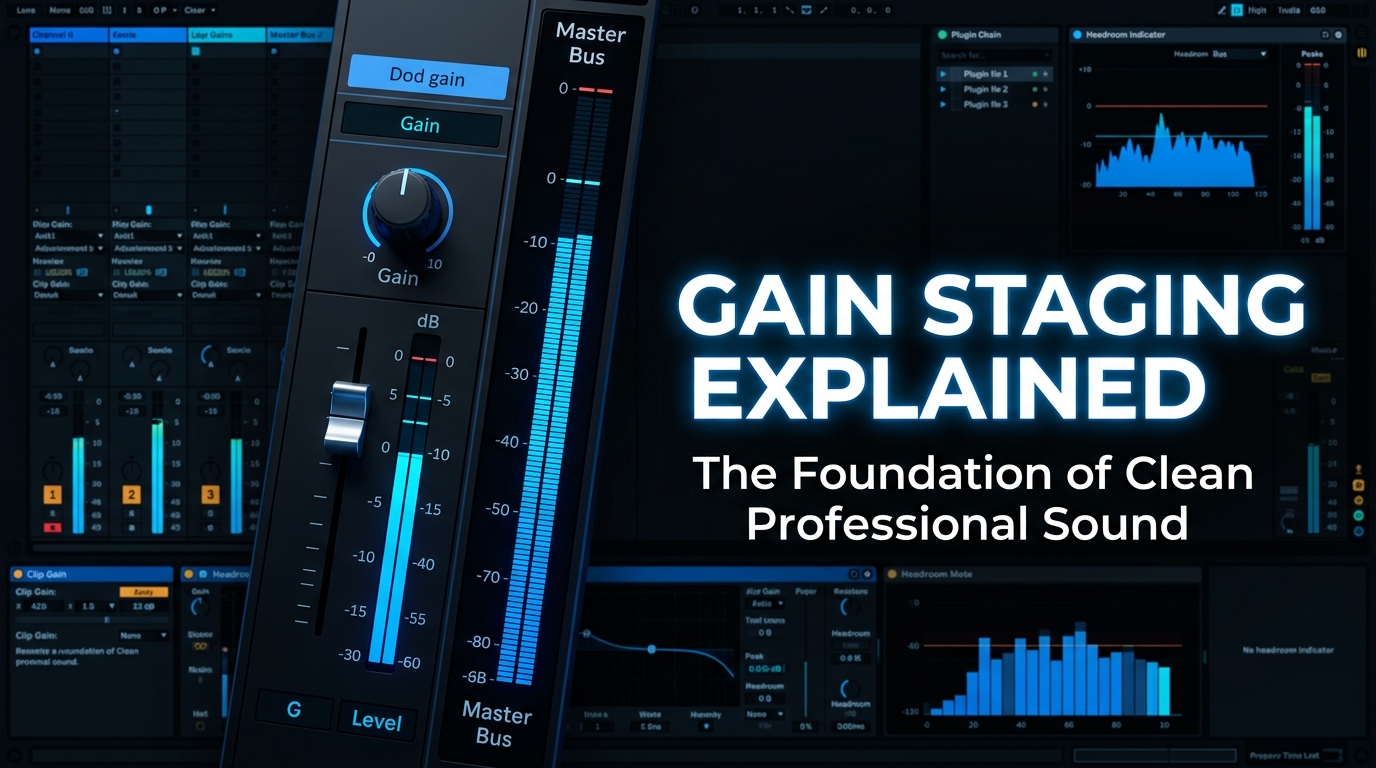
Gain Staging Explained: The Foundation of Clean and Professional Music Production
In modern music production, many problems that appear during mixing or mastering actually start much earlier in the process. Distortion, lack of clarity, weak dynamics, and inconsistent loudness often have one root cause: poor gain staging.
Gain staging is one of the most fundamental skills every producer must understand. It ensures that audio signals flow through your production chain at the correct levels, maintaining clarity, headroom, and dynamic range from recording to final mastering.
Without proper gain staging, even the best plugins and mixing techniques cannot deliver professional results.
What Is Gain Staging?
Gain staging is the process of managing audio levels throughout the entire signal chain to prevent distortion, noise, and loss of dynamic range.
This includes controlling levels at every stage of production:
- Recording input levels
- Plugin input and output levels
- Channel faders
- Bus levels
- Master channel levels
- Export levels
The goal is simple:
Maintain healthy signal levels from start to finish.
Gain staging is not about making things louder — it is about keeping audio clean and balanced.
Why Gain Staging Is So Important in Modern Production
Today’s productions use multiple plugins, virtual instruments, and effects chains. Each processor affects signal levels, and small mistakes can quickly accumulate.
Poor gain staging can cause:
- Digital clipping
- Unwanted distortion
- Muddy mixes
- Loss of dynamics
- Plugin overload
- Inconsistent loudness
- Reduced headroom
- Mastering problems
Proper gain staging prevents these issues before they appear.
Understanding Headroom
Headroom refers to the space between your current signal level and the maximum level before clipping occurs.
In digital audio, clipping happens at:
0 dBFS
Professional producers leave extra headroom during mixing to ensure safe processing later in the workflow.
Typical headroom targets during mixing:
-6 dB to -3 dB peak on the master channel
This provides enough space for mastering adjustments without introducing distortion.
The Difference Between Gain and Volume
Many producers confuse gain with volume, but they serve different purposes.
Gain controls the strength of the audio signal entering a processor.
Volume controls how loud the signal is at the output.
Understanding this distinction is essential for maintaining consistent levels throughout a session.
In practice:
Gain shapes the signal
Volume controls playback level
This small difference has a big impact on audio quality.
Where Gain Staging Happens in the Production Process
Gain staging is not a single step — it happens continuously throughout the entire workflow.
Recording Stage
During recording, input levels must be set carefully to avoid clipping while maintaining a strong signal.
Recommended recording levels:
Peak range:
−12 dB to −6 dB
This ensures clean recordings with sufficient headroom.
Mixing Stage
During mixing, each track should be balanced to maintain clarity and prevent overload on the master bus.
Key goals during mixing:
- Balanced channel levels
- Controlled plugin input levels
- Consistent bus levels
- Adequate headroom
Mastering Stage
In mastering, gain staging ensures the limiter and processing chain operate efficiently.
Proper levels allow mastering tools to:
- Increase loudness cleanly
- Preserve dynamics
- Prevent distortion
- Maintain clarity
Gain staging at this stage directly affects final sound quality.
Gain Staging and Plugins
Every plugin processes audio differently. Some plugins are designed to work best at specific input levels.
For example:
Analog-modeled plugins often expect signals around:
−18 dBFS
Feeding signals that are too hot into these processors can cause:
- Harsh distortion
- Unpredictable compression
- Loss of transparency
Managing plugin input levels ensures consistent behavior across your signal chain.
The Role of Metering in Gain Staging
Meters are essential tools for monitoring signal levels during production.
Common metering tools include:
- Peak meters
- RMS meters
- LUFS meters
- VU meters
- True peak meters
These tools provide visual feedback that helps producers maintain safe and consistent levels.
Professional workflows rely heavily on accurate metering.
Common Gain Staging Mistakes Producers Make
Even experienced producers sometimes overlook basic level management.
Here are the most common mistakes:
Recording signals too hot
Ignoring plugin input levels
Overloading the master channel
Using excessive limiting
Stacking multiple gain boosts
Skipping level monitoring
Mixing without headroom
These mistakes often lead to poor sound quality and difficult mastering sessions.
A Simple Gain Staging Workflow
A reliable workflow helps maintain consistent levels across projects.
Basic gain staging process:
- Set recording levels between −12 dB and −6 dB
- Adjust track gain before inserting plugins
- Monitor plugin input and output levels
- Balance channel faders
- Keep master peaks below −6 dB
- Leave headroom for mastering
This workflow ensures stable and predictable sessions.
How Gain Staging Improves Mix and Master Quality
Proper gain staging creates a strong technical foundation for every production stage.
Benefits include:
Cleaner mixes
Better dynamics
More headroom
Reduced distortion
More predictable plugin behavior
Stronger mastering results
Professional sound quality
Many mixing and mastering problems disappear when gain staging is done correctly.
Gain Staging in Modern DAWs
Modern Digital Audio Workstations provide tools that make gain staging easier than ever.
Common built-in features include:
- Input gain controls
- Clip gain adjustment
- Channel meters
- Gain utility plugins
- Bus routing tools
- Real-time level monitoring
These tools allow producers to manage levels quickly and accurately.
Understanding how to use them is a key professional skill.
Why Gain Staging Is the Hidden Secret of Professional Producers
Professional producers rarely struggle with distortion or inconsistent loudness because they control levels from the beginning of the workflow.
Gain staging is not a complex technique — it is a disciplined habit.
When levels are managed properly:
Plugins work better
Mixes sound cleaner
Masters sound louder
Sessions remain stable
Production becomes faster
This is why gain staging is considered one of the most important foundations of modern music production.
Conclusion
Gain staging is the backbone of clean, professional audio production.
It protects your sound quality, improves workflow stability, and prepares your music for successful mixing and mastering.
For producers who want consistent, reliable results, mastering gain staging is not optional — it is essential.